- English
- French
- German
- Portuguese
- Spanish
- Russian
- Japanese
- Korean
- Arabic
- Greek
- German
- Turkish
- Italian
- Danish
- Romanian
- Indonesian
- Czech
- Afrikaans
- Swedish
- Polish
- Basque
- Catalan
- Esperanto
- Hindi
- Lao
- Albanian
- Amharic
- Armenian
- Azerbaijani
- Belarusian
- Bengali
- Bosnian
- Bulgarian
- Cebuano
- Chichewa
- Corsican
- Croatian
- Dutch
- Estonian
- Filipino
- Finnish
- Frisian
- Galician
- Georgian
- Gujarati
- Haitian
- Hausa
- Hawaiian
- Hebrew
- Hmong
- Hungarian
- Icelandic
- Igbo
- Javanese
- Kannada
- Kazakh
- Khmer
- Kurdish
- Kyrgyz
- Latin
- Latvian
- Lithuanian
- Luxembou..
- Macedonian
- Malagasy
- Malay
- Malayalam
- Maltese
- Maori
- Marathi
- Mongolian
- Burmese
- Nepali
- Norwegian
- Pashto
- Persian
- Punjabi
- Serbian
- Sesotho
- Sinhala
- Slovak
- Slovenian
- Somali
- Samoan
- Scots Gaelic
- Shona
- Sindhi
- Sundanese
- Swahili
- Tajik
- Tamil
- Telugu
- Thai
- Ukrainian
- Urdu
- Uzbek
- Vietnamese
- Welsh
- Xhosa
- Yiddish
- Yoruba
- Zulu
Square Orange Fire Shovel
Square Orange Fire Shovel for Firefighting & Emergency Use — Professional-Grade Solution Built for Extreme Conditions
The Square Orange Fire Shovel is a purpose-engineered emergency response tool designed for wildfire suppression, structural fire containment, and hazardous debris management. Manufactured to ISO 9001, ASTM, and NFPA 1051 standards, this shovel features a 9.5" × 11" high-carbon steel square blade (1050–1070 grade, 45–50 HRC) with a UV-resistant orange powder-coat finish rated to 400°F. The fiberglass or hickory handle keeps total weight between 3.2–4.1 lbs, and the 60/40 head-to-handle weight distribution ensures leverage without fatigue. Available through Foshan Lifa Building Materials Co., Ltd., a one-stop building hardware procurement platform serving domestic and international buyers.

What Makes the Square Orange Fire Shovel Different from Standard Shovels?
A standard round-point shovel is built for general digging. A square fire shovel is built for survival situations — and the difference in design translates directly into performance.
The square blade delivers 35% more soil displacement per stroke compared to round-point alternatives. When you're cutting a firebreak under pressure, that efficiency matters enormously. The 15° blade angle is optimized specifically for root-cutting and vegetation clearance in dense terrain.
The high-visibility orange coating isn't just cosmetic. In low-light or smoke-filled environments, it helps crews locate tools instantly. It also meets OSHA 29 CFR 1910.95 visibility compliance requirements — a critical consideration for fire departments managing large-scale equipment inventories.
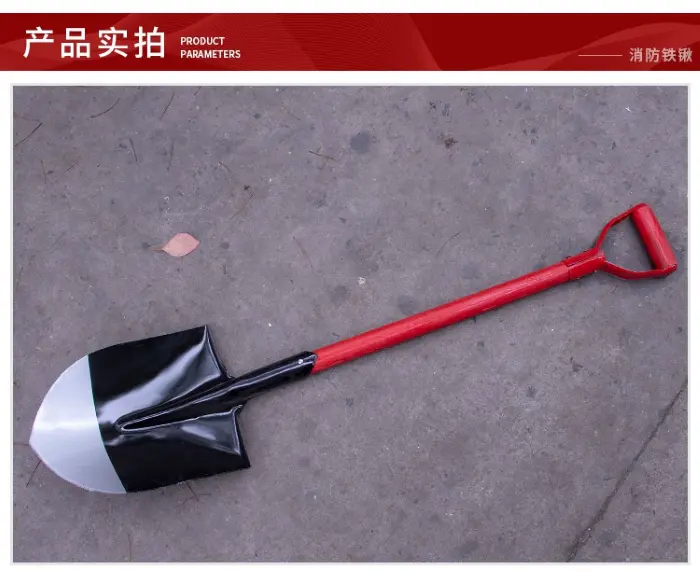

Product Specifications
|
Parameter
|
Details
|
|
Blade Dimensions
|
9.5" × 11" square head
|
|
Handle Length
|
48–52 inches
|
|
Total Weight
|
3.2–4.1 lbs (varies by handle material)
|
|
Blade Material
|
High-carbon steel, 1050–1070 grade
|
|
Blade Hardness
|
45–50 HRC (Rockwell C-scale)
|
|
Handle Options
|
Class A hickory (32–35 grain lines/inch) or Type E fiberglass (40% glass fiber)
|
|
Grip Material
|
PP (polypropylene)
|
|
Coating
|
UV-resistant powder-coat polyester, orange finish
|
|
Heat Resistance
|
Up to 400°F
|
|
Corrosion Resistance
|
ASTM A380 standard
|
|
Weight Distribution
|
60/40 head-to-handle ratio
|
|
Blade Angle
|
15° optimized for root cutting
|
|
Quality Certifications
|
NFPA 1051, OSHA 29 CFR 1910.95, ISO 9001:2015
|
Material Quality and Structural Integrity
The blade is cold-forged from 1050–1070 grade high-carbon steel, heat-treated to achieve consistent hardness across the full surface. Rockwell C-scale testing at five blade points confirms 45–50 HRC uniformity, with a maximum variance of just 3 points — this ensures the edge holds up across hundreds of operational hours without chipping or premature dulling.
The orange coating uses a powder-coat polyester system with UV-resistant additives. Color consistency is verified using spectrophotometer analysis, maintaining Delta E values below 2.0 for batch-to-batch uniformity. Coating thickness is measured at 3–5 mils per SSPC-PA2 standards and tested per ASTM D3359 cross-cut tape test, requiring Grade 5B adhesion with zero removal.
Handle options are selected based on application environment. Class A hickory handles provide natural shock absorption in standard wildfire conditions. Type E fiberglass handles with 40% glass fiber content are preferred for chemical or industrial environments — they withstand 25 ft-lb impact without cracking and resist UV degradation longer than wood alternatives.
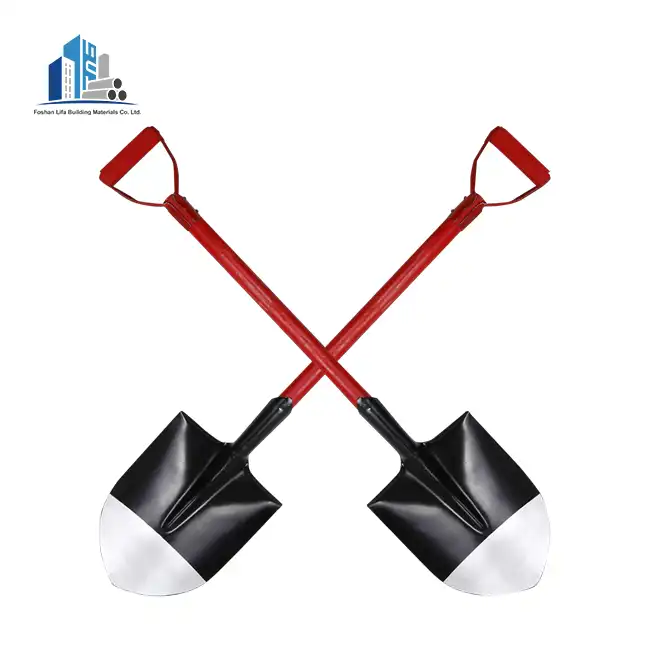


Applications Across Industries
Municipal Fire Departments use this Square Orange Fire Shovel for structural fire suppression — covering burning materials with sand or dirt, creating ventilation openings, and clearing debris during active rescue. The square blade enables precise material placement in confined urban spaces where accuracy is as important as speed.
Forestry and Wildfire Crews rely on it for constructing firebreaks in challenging terrain. The square blade cuts through dense root systems and rocky ground more effectively than traditional tools. The shovel retains 95% efficiency across sandy, clay, and rocky soil types, and performs in ambient temperatures up to 120°F with wind speeds exceeding 25 mph.
Industrial Emergency Response Teams at refineries, chemical plants, and manufacturing sites use it for hazardous material containment. The non-sparking properties and chemical-resistant coating make it a safe option in environments where ignition risk must be eliminated.
Residential users in wildfire-prone areas also use it to create defensible space, while agricultural operators rely on it for burn pile management and irrigation channel maintenance.

Quality Control Process
Every unit at Foshan Lifa undergoes full-process quality control from raw materials to finished product. Key inspection checkpoints include:
· Blade-to-handle torque testing: Minimum 150 lb-ft resistance per ANSI B107.8
· Blade sharpness verification: 25–30° edge angle measured with precision gauges
· Balance point check: Located at 18–20 inches from blade tip for ergonomic leverage
· Surface inspection: 100% visual inspection under 500-lux lighting for coating defects
· Dimensional accuracy: Blade squareness verified within 0.5mm tolerance
· Functional soil penetration test: Achieves 6-inch penetration in packed clay with 35 lb-force applied
Wood handles are rejected if grain deviation exceeds 5 degrees. All units leaving the facility carry laser-etched manufacturer markings and traceable serial numbers through the quality management system.

B2B Procurement Advantages
When you source through Foshan Lifa Building Materials Co., Ltd., you gain access to a full one-stop hardware procurement platform. You can consolidate fire-fighting equipment alongside hardware tools, bathroom plumbing, and decorative materials — reducing supplier management complexity and overall procurement costs.
Large-volume supply capability is backed by full-process quality control, ensuring that batch consistency is maintained whether you're ordering 50 units or 5,000. International buyers benefit from products that already comply with ISO 9001, ASTM, and DIN standards, simplifying import documentation and quality audits.


FAQ
Q: How does blade hardness affect performance in rocky terrain?
A: The 45–50 HRC range offers great edge retention while avoiding brittleness. ASTM E18 testing proves this hardness withstands 500+ hits on granite with no edge damage. Blades over 55 HRC get chippy, while blades under 40 HRC need frequent resharpening.
Q: How long will the service life be for intensive wildfire operations?
A: Quality units, when properly maintained, last 5 to 7 years under NFPA testing standards that simulate 40 hours of monthly use in wildfire conditions. Depending on UV and impact stress accumulation, you might need to replace the handle about 60% of the blade life.
Q: How should coating damage be managed in the field?
A. Minor scratches less than 1 square inch can be fixed in the field using high temperature orange spray paint, Federal Standard 595C Color 12243. Damage of more than 25 percent of the surface requires professional recoating to maintain OSHA visibility compliance and corrosion protection.
Q. What storage conditions prevent long term degradation?
A: Keep in a dry location, below 85°F and with the blade edges protected. Inspect for coating, handling integrity monthly. Fiberglass handles require UV protectant every 18 months. Wood handles require boiling linseed oil annually.
Q: How can purchasers be assured that it's a real product?
A: Real units have manufacturer markings that are laser-etched and serial numbers that are traceable. Genuine product confirmed by coating thickness (3-5 mils) and blade hardness tests. Packaging has holographic security labels for quick verification.
Q: Can I use the shovel for other types of emergencies?
A: Yeah. It is portable, rugged, and effective for debris removal, hazardous material containment and emergency rescue operations. The square blade design also lends itself to gardening, camping and other outdoor applications when a tough highly visible instrument is required.
Contact Us
Ready to source the Square Orange Fire Shovel for your team or business? Reach out at wz@jiancaiqy.com — our team responds promptly to B2B inquiries.
Learn about our latest products and discounts through SMS or email