- English
- French
- German
- Portuguese
- Spanish
- Russian
- Japanese
- Korean
- Arabic
- Greek
- German
- Turkish
- Italian
- Danish
- Romanian
- Indonesian
- Czech
- Afrikaans
- Swedish
- Polish
- Basque
- Catalan
- Esperanto
- Hindi
- Lao
- Albanian
- Amharic
- Armenian
- Azerbaijani
- Belarusian
- Bengali
- Bosnian
- Bulgarian
- Cebuano
- Chichewa
- Corsican
- Croatian
- Dutch
- Estonian
- Filipino
- Finnish
- Frisian
- Galician
- Georgian
- Gujarati
- Haitian
- Hausa
- Hawaiian
- Hebrew
- Hmong
- Hungarian
- Icelandic
- Igbo
- Javanese
- Kannada
- Kazakh
- Khmer
- Kurdish
- Kyrgyz
- Latin
- Latvian
- Lithuanian
- Luxembou..
- Macedonian
- Malagasy
- Malay
- Malayalam
- Maltese
- Maori
- Marathi
- Mongolian
- Burmese
- Nepali
- Norwegian
- Pashto
- Persian
- Punjabi
- Serbian
- Sesotho
- Sinhala
- Slovak
- Slovenian
- Somali
- Samoan
- Scots Gaelic
- Shona
- Sindhi
- Sundanese
- Swahili
- Tajik
- Tamil
- Telugu
- Thai
- Ukrainian
- Urdu
- Uzbek
- Vietnamese
- Welsh
- Xhosa
- Yiddish
- Yoruba
- Zulu
How Does an Industrial‑Grade Electric Mixer Improve Productivity?
Picture this: your construction crew stands idle, waiting for manually mixed concrete to reach the right consistency. Time ticks away, labor costs climb, and project deadlines loom closer. This common pain point haunts contractors daily—inconsistent mixing, exhausted workers, and productivity that crawls instead of sprints. An Industrial-Grade Electric Mixer transforms this frustrating scenario by automating material preparation, delivering uniform results in a fraction of the time. This powerful tool eliminates the guesswork and physical strain of manual mixing while drastically accelerating workflow across construction, renovation, and manufacturing projects.
Why Industrial-Grade Electric Mixers Are Essential for Modern Construction Projects?
The construction industry faces mounting pressure to complete projects faster without sacrificing quality. Traditional manual mixing methods no longer meet the demands of contemporary building sites where efficiency directly impacts profitability. An Industrial-Grade Electric Mixer addresses this challenge by combining robust engineering with intelligent design features that streamline material preparation from start to finish. Modern construction projects involve diverse materials—concrete, mortars, adhesives, paints, and specialized grout formulations—each requiring precise consistency for optimal performance. Manual mixing produces inconsistent results that compromise structural integrity and finish quality. Workers experience fatigue that slows productivity and increases error rates, particularly when handling multiple batches throughout the workday. The Industrial-Grade Electric Mixer eliminates these variables by providing consistent power delivery and controlled mixing action regardless of material density or batch size. Professional contractors recognize that equipment reliability determines project success. Heavy-duty construction demands tools that withstand continuous operation under challenging conditions. Industrial-Grade Electric Mixers feature reinforced motor housings, heat-resistant components, and sealed bearings that protect against dust, moisture, and material splatter. This durability translates to fewer breakdowns, reduced maintenance costs, and uninterrupted workflow that keeps projects moving forward according to schedule.
Automated Consistency Reduces Rework and Material Waste
Material waste represents a significant hidden cost in construction operations. Improperly mixed batches often require disposal and reformulation, doubling material expenses and labor time. An Industrial-Grade Electric Mixer ensures thorough blending that activates all chemical components properly, whether working with cementitious products, epoxy systems, or specialty coatings. The S-type stirring mechanism creates optimal flow patterns that eliminate clumps and dry pockets, producing uniform consistency from the first batch to the last. Quality control becomes simpler when mixing parameters remain constant. Professional-grade electric mixers maintain consistent rotation speeds and torque output that produce repeatable results. Workers spend less time adjusting technique or compensating for equipment limitations, allowing them to focus on application rather than preparation. This standardization proves especially valuable when training new crew members or coordinating work across multiple teams on large-scale projects.
Multi-Speed Control Adapts to Different Material Requirements
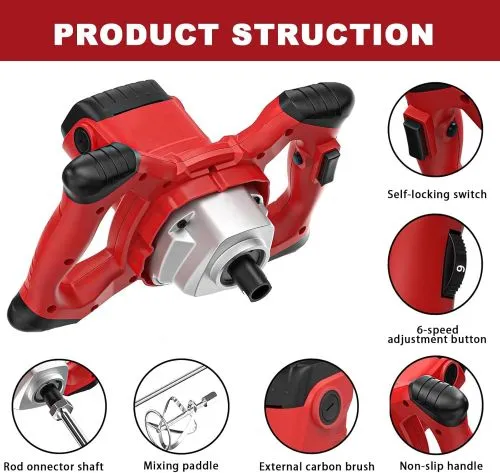
Construction materials vary dramatically in viscosity and composition. Thin paint requires different mixing speeds than thick concrete or heavy mortar. An Industrial-Grade Electric Mixer with 6-speed regulation provides the flexibility to match mixing intensity to material characteristics. Lower speeds handle delicate formulations that could separate or aerate under aggressive agitation, while higher speeds power through dense, heavy materials that resist blending. This adjustable speed capability extends equipment versatility across project phases. The same mixer that prepares foundation concrete in the morning can switch to mixing joint compound for finishing work in the afternoon. Contractors eliminate the need for multiple specialized tools, reducing equipment investment and simplifying logistics. The ability to fine-tune mixing speed also improves material performance—properly blended adhesives bond stronger, coatings flow smoother, and concrete cures with optimal strength characteristics.
How Electric Mixers Accelerate Project Timelines and Boost Workforce Efficiency?
Time management determines construction profitability. Every minute saved in preparation translates to faster project completion and reduced labor costs. Industrial-Grade Electric Mixers dramatically compress the material preparation phase by accomplishing in seconds what manual methods require minutes to achieve. This acceleration creates a ripple effect throughout the entire workflow, allowing crews to maintain momentum and complete more work during each shift. Labor productivity extends beyond raw speed to include worker energy conservation and job site safety. Manual mixing demands significant physical exertion that fatigues workers and increases injury risk. Repetitive stirring motions strain shoulders, backs, and arms, reducing work capacity as the day progresses. The handheld design of modern Industrial-Grade Electric Mixers minimizes operator effort while maximizing output. Workers maintain consistent productivity throughout extended shifts because the equipment handles the demanding work of material agitation.

Reducing Setup and Cleanup Time
Traditional mixing methods involve considerable setup and cleanup that consumes valuable production time. Bucket mixers require careful positioning, while manual tools need constant adjustment during use. An Industrial-Grade Electric Mixer simplifies the entire process with intuitive operation that reduces training requirements and accelerates deployment. The handheld configuration allows operators to mix directly in material containers, eliminating transfer steps that risk spillage and contamination. Cleanup efficiency matters as much as mixing speed. Construction materials often contain abrasive particles or reactive chemicals that complicate tool maintenance. Professional electric mixers feature removable stirring components and smooth surfaces that shed material buildup during washing. Quick-disconnect paddles enable rapid changeover between material types without cross-contamination risk. This streamlined maintenance allows crews to transition between tasks without lengthy interruptions, maintaining project flow throughout the workday.
Supporting Large-Volume Production Demands
Major construction projects require enormous quantities of mixed materials. Foundation work alone might demand hundreds of batches of concrete mixed to precise specifications. An Industrial-Grade Electric Mixer handles high-volume production without performance degradation. The heavy-duty motor design delivers consistent power output through extended operating periods, while effective heat dissipation prevents thermal overload that compromises less robust equipment. Batch consistency becomes critical when producing large quantities. Structural concrete must maintain uniform strength characteristics throughout pours that span multiple batches and work crews. The Industrial-Grade Electric Mixer guarantees that batch fifty matches batch one in composition and quality. This reliability proves essential for applications where material performance directly impacts safety and structural integrity, from high-rise construction to infrastructure development.
Technical Features That Drive Productivity Improvements
Understanding the engineering behind Industrial-Grade Electric Mixers reveals why these tools deliver such dramatic productivity gains. Every design element serves a specific purpose in optimizing mixing performance, operator comfort, and equipment longevity. The combination of powerful motors, intelligent control systems, and robust mechanical components creates a tool that consistently outperforms alternatives across all performance metrics. Motor specifications determine mixing capability. Industrial-Grade Electric Mixers typically feature motors ranging from 5 to 20 horsepower, providing ample power reserves to handle challenging materials without bogging down. This power advantage proves especially valuable when mixing high-density concrete or thick mortars that overwhelm weaker equipment. The high-torque characteristics of professional-grade motors maintain consistent rotation speed under load, preventing the speed fluctuations that produce uneven mixing results.
Ergonomic Design Minimizes Operator Fatigue
Worker comfort directly affects productivity and safety. Poorly balanced tools cause unnecessary strain that reduces work quality and increases accident risk. Industrial-Grade Electric Mixers incorporate ergonomic handle designs that distribute weight evenly across the operator's grip. Strategic handle placement aligns with natural body mechanics, reducing awkward postures that lead to fatigue and discomfort during extended use. Vibration control represents another critical comfort factor. Powerful mixing action generates substantial vibration forces that transfer through tool handles to operators. Excessive vibration causes hand-arm fatigue and potential long-term health issues. Quality Industrial-Grade Electric Mixers feature damping systems that absorb vibration before it reaches the operator, allowing comfortable operation through full work shifts without numbness or strain.
Safety Features Protect Workers and Equipment
Construction site safety demands equipment that protects operators from potential hazards. Industrial-Grade Electric Mixers incorporate multiple safety systems that prevent accidents while safeguarding the tool itself from damage. Lock-on buttons enable continuous operation without maintaining constant trigger pressure, reducing hand fatigue while keeping mixing consistent during long batches. Safety switches provide instant power cutoff if operators need to address unexpected situations. Overload protection systems monitor motor current and temperature to prevent damage from excessive loading or inadequate cooling. These intelligent circuits automatically reduce power output or shut down operation before components overheat or fail. This self-protection extends equipment lifespan while preventing the costly downtime and repairs associated with motor burnout. Enclosed control boxes shield electrical components from moisture and material splatter that could cause short circuits or premature failure.
Real-World Applications Demonstrating Productivity Impact
The true measure of equipment value lies in actual job site performance. Industrial-Grade Electric Mixers deliver measurable productivity improvements across diverse construction applications, from residential renovation to commercial infrastructure development. Understanding these practical applications helps contractors recognize opportunities to enhance their own operations through strategic equipment upgrades. Masonry work demands precise mortar consistency that balances workability with bonding strength. Too dry and blocks won't set properly; too wet and joints sag before curing. An Industrial-Grade Electric Mixer eliminates the guesswork by thoroughly blending cement, sand, and water to optimal consistency every time. Masons work faster knowing each batch will perform identically, allowing them to establish a steady rhythm that maximizes wall construction speed.
Concrete Placement and Repair Operations
Concrete work represents one of the most demanding mixing applications in construction. Small repair jobs require quickly mixing precise quantities to match existing concrete characteristics. Large placements demand continuous production of uniform material that flows consistently and cures with reliable strength properties. The Industrial-Grade Electric Mixer handles both scenarios with equal effectiveness, scaling from single-bucket repairs to full foundation pours without performance compromise. Specialty concrete applications benefit particularly from controlled mixing. Decorative overlays, self-leveling toppings, and repair mortars contain precise additive ratios that require thorough dispersion for proper performance. The powerful agitation provided by Industrial-Grade Electric Mixers ensures complete integration of fibers, polymers, and chemical admixtures throughout the mix. This thorough blending activates all material components properly, producing the enhanced performance characteristics these specialized products promise.
Paint and Coating Application Projects
Surface preparation and finishing work increasingly rely on advanced coating systems that demand careful mixing. Multi-component epoxies, texture additives, and tinting pigments must blend completely to achieve specified appearance and performance properties. Manual stirring rarely achieves the dispersion quality necessary for professional results. An Industrial-Grade Electric Mixer provides the thorough agitation needed to suspend heavy pigments, incorporate texture materials, and activate chemical cross-linking in reactive coatings. Large-scale painting projects consume substantial coating volumes that require consistent batch preparation throughout application. Color-critical work demands identical pigment dispersion across every container to prevent shading variations on finished surfaces. The Industrial-Grade Electric Mixer guarantees repeatable mixing action that maintains color consistency from start to finish. Painters work confidently knowing material performance will remain constant, allowing them to focus on application technique rather than worrying about product variation.
Selecting the Right Industrial-Grade Electric Mixer for Your Needs
Equipment investment requires careful consideration of project requirements, material characteristics, and operational demands. Not all Industrial-Grade Electric Mixers offer identical capabilities, and matching tool specifications to actual needs ensures optimal performance and value. Understanding key selection criteria helps contractors make informed decisions that enhance productivity while avoiding unnecessary features that inflate costs without delivering practical benefits. Motor power requirements scale with material density and batch size. Light renovation work mixing paint and thin mortars succeeds with moderate power levels, while heavy construction demanding concrete and thick grout preparation requires high-horsepower motors that maintain torque under extreme loads. Assess typical material viscosities and container sizes to identify appropriate power specifications that handle your standard workload without excessive capacity that drives up initial investment.
Capacity and Speed Range Considerations
Mixing capacity determines batch efficiency and production volume capabilities. Small-batch work benefits from compact mixers that prepare precise quantities without waste, while large projects require equipment capable of handling substantial volumes efficiently. Consider typical batch sizes across your project mix to identify capacity requirements that balance flexibility with productivity. Equipment that processes your most common batch sizes efficiently optimizes return on investment. Speed range flexibility affects material compatibility and mixing quality. Variable speed control allows a single mixer to handle diverse materials across projects without requiring multiple specialized tools. Six-speed regulation provides sufficient adjustment range for most construction applications, from thin paint coatings through thick concrete formulations. This versatility simplifies equipment management and reduces the total tool inventory required to serve varied project demands.
Build Quality and Durability Standards
Construction equipment endures harsh operating conditions that quickly expose quality shortcomings. Industrial-Grade Electric Mixers built with professional-grade components withstand the rigors of daily job site use far better than consumer-grade alternatives. Stainless steel shafts and paddles resist corrosion and abrasion that degrade lesser materials, maintaining mixing efficiency through years of service. Sealed bearings exclude dust and moisture that accelerate wear in exposed mechanisms. Motor construction determines reliability under stress. Completely enclosed motor housings protect windings from dust ingress and material contamination that cause premature failure. Quality insulation systems withstand temperature extremes encountered during continuous heavy-load operation. Heat dissipation features prevent thermal damage that compromises motor longevity. These engineering details separate professional tools from hobby-grade equipment that fails under sustained construction demands.

Conclusion
Industrial-Grade Electric Mixers revolutionize construction material preparation by delivering automated consistency, accelerated production, and enhanced worker safety. These robust tools eliminate manual mixing limitations while dramatically improving project efficiency across diverse applications.
Cooperate with Foshan Lifa Building Materials Co., Ltd.
Ready to transform your construction productivity with professional-grade mixing solutions? Foshan Lifa Building Materials Co., Ltd. stands as your trusted China Industrial-Grade Electric Mixer manufacturer and China Industrial-Grade Electric Mixer supplier, offering superior equipment backed by ISO9001, CE, and RoHS certifications. Our China Industrial-Grade Electric Mixer factory produces High Quality Industrial-Grade Electric Mixer units featuring 6-speed control, heavy-duty construction, and competitive Industrial-Grade Electric Mixer price points. With Industrial-Grade Electric Mixer for sale through our China Industrial-Grade Electric Mixer wholesale program, we serve 30+ countries with reliable OEM/ODM support, extensive inventory for immediate shipment, and expert technical guidance. Contact our professional team at wz@jiancaiqy.com today to discuss your specific mixing requirements and discover how our building hardware solutions enhance your operational success.
References
1. "Industrial Mixing Technology and Process Efficiency" by Robert E. Brennan, published in Chemical Engineering Progress Journal
2. "Construction Equipment and Productivity Analysis" by Michael T. Henderson, Manufacturing Engineering Research Institute
3. "Advanced Materials Processing in Modern Construction" by Dr. Sarah Chen, International Journal of Building Technology
4. "Mixer Design and Performance Optimization" by James Mitchell, Industrial Equipment Engineering Quarterly
5. "Workplace Efficiency in Construction Operations" by David Richardson and Emily Thompson, Construction Management Research Foundation
Learn about our latest products and discounts through SMS or email